I can imagine the vision of being in space and looking at earth very clearly. It is the
feeling of silence in certain parts of the song even though the band is still playing and that's what strikes me. There's a continuous play but the band wisely produced the track to have spots of detachment.
We can hear the floating already with the first guitar melody, accompained by organ [0:33]. Then again on [4:57] comes the piano, plays alone the verse chords and then changes between scale degrees with the bass and together they deliver quiet.
It is very hard to deliver a story in music, not in a kitschy way. The story in Gravity is visible and told elegantly.
Another noticeable thing is the pedantry in producing the song as a band. Every instrument plays a certain part for the goal of making one piece as a whole. They thought about all small details of sound, I bet down to the frequencies. I'm sure that the pedant musicians among us are familiar with this impulse.
Moving on to our favorite part in Scaleter.com.
Scaleter's Notes
Here is where interesting music elements are being mentioned, theoretical and artistic expressions that are worthy of noticing.
Gravity by no gravity
So the title of the song is Gravity, but guess what, Telegraph are actually taking us off the ground. Because what is the best way to present gravity if not by detaching from it?
As presented earlier, we get the two "quiet" parts as an image of space. However, there's also a musical element to give us that feeling. It is the
consistent scales change. Multiple times during the song where the song is changing ground and sends us the floating feeling.
Gravity begins on A major, and ends on B minor. We don't end at the same spot which we started and that by itself sends a floating message.
On 2:57, after playing on E minor scale repeatitively, a new degree shows up, the seventh, a chord that wasn't brought before. It gives us the illusion that another change of scales just happened but we actually stay on E minor.
Two more ways of lifting us off the ground using scales is replacing between A major and A minor at the same piece, and using C major and C# major which are very far from one another! A list of all scales with the chord degrees which are used in the song, along the time of performance is shown next:
A
VI-I X16
Piano [2:08]
Em
I-VI-IV-I X2 [2:22]
I-VII-VI-IV X2 [2:53]
I-VI-IV-VI-IV-I-I [3:25]
C#m
VI-I X4 [3:53]
A
VI-I X4 [4:25]
Piano
VI-I X4 [4:57]
Am
IV-I-V-II X2 [5:29]
Cm
I-Vm-I-IV X2 [6:01]
G
I-VII X4 [6:33]
Cm
I-Vm-I-IV x2 [7:05]
Am
IV-I-V-II [7:37]
IV-I-V [7:53]
V/E [8:05]
Bm [8:13]
At a glance, these multiple changes might appear as a chaos (which might have been done with intention) but in-fact, while listening to Gravity, all changes fit so smoothly together, like they all have gravity. Fabulous.
Parallel melody lines
There are two incidents in which, in my view, we get close to the human point of view. In both there is a
joint of two voices.
First example is the wailing of the guitar, hitting with the guitar pick on two voices in octave interval. The double hit on the string is quite uncommon and gives the moment a human character [1:52].
Second is the lovely cooporation of the piano and the bass in 5:46, going down with the melody together, in a third interval between them. A one-time unforgettable act that again, resembles human touch.
Visit the facebook page of Telegraph
Youtube |
Bandcamp |
Spotify |
Apple Music
Next Scaleter's Choice is soon

 Last time I presented a band playing a kind of progressive rock and dedicating a song to a specific musician. This time, it's a progressive rock band dedicating a whole album to the story of Sergei Krikalev, a russian cosmonaut who spent a lot of time in Mir space station in 1991.
This israeli band is called
Last time I presented a band playing a kind of progressive rock and dedicating a song to a specific musician. This time, it's a progressive rock band dedicating a whole album to the story of Sergei Krikalev, a russian cosmonaut who spent a lot of time in Mir space station in 1991.
This israeli band is called
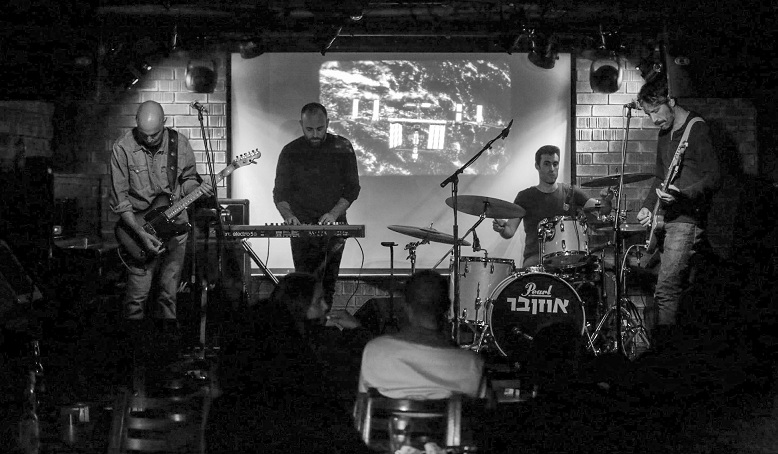 The track presented here is called Gravity. The song is like a whole world by itself and if you ask me, it's only a small part of the album which illustrates an enormous dimension of the universe. Because you can really sense the space when listening. Plus, there's the idea behind the album and the songs connect to each other, telling one big story.
And these are the personnel behind this creation:
The track presented here is called Gravity. The song is like a whole world by itself and if you ask me, it's only a small part of the album which illustrates an enormous dimension of the universe. Because you can really sense the space when listening. Plus, there's the idea behind the album and the songs connect to each other, telling one big story.
And these are the personnel behind this creation: